Black Tax

How Culture and Family Shape Economic Decisions in Namibia
Why do people take risks, and why are some of us much more willing to do so than others? Many factors shape our attitude towards risk. Our emotional and cultural environment is one of them.
For my Bachelor’s thesis, I explored this question through a perspective that has received relatively little attention so far: family expectations in a post-colonial context. Under the supervision of Prof. Dr Marcus Giamattei and with financial support from the Reinhard Selten Scholarship of the Gesellschaft für experimentelle Wirtschaftsforschung, I conducted an experiment in Namibia in Southern Africa. At the heart of my research was what is known as Black Tax, which plays an important role for many Black families today.
When cultural expectations become Black Tax
By commonly used measures, Namibia is one of the most unequal countries in the world. The reasons are deeply rooted in the country’s complex history and go well beyond the scope of this article. But one development is particularly relevant to my research: since Namibia gained independence in 1990 after a long struggle, the first generation of so-called ‘freeborns’ has now entered the labour market.
Black Tax describes a widespread cultural norm or expectation. Family members who often live in cities and have regular employment pass on a significant share of their income to other members of their family. The reasons behind this practice are not yet fully understood.
Some explanations refer to Ubuntu, a philosophy often expressed through the idea that ‘a person is a person through other people’. Alongside this strong sense of community, there is often an expectation of gratitude and a desire to give back in recognition of the upbringing or education one has received.
Digital balloons as a proxy for risk-taking
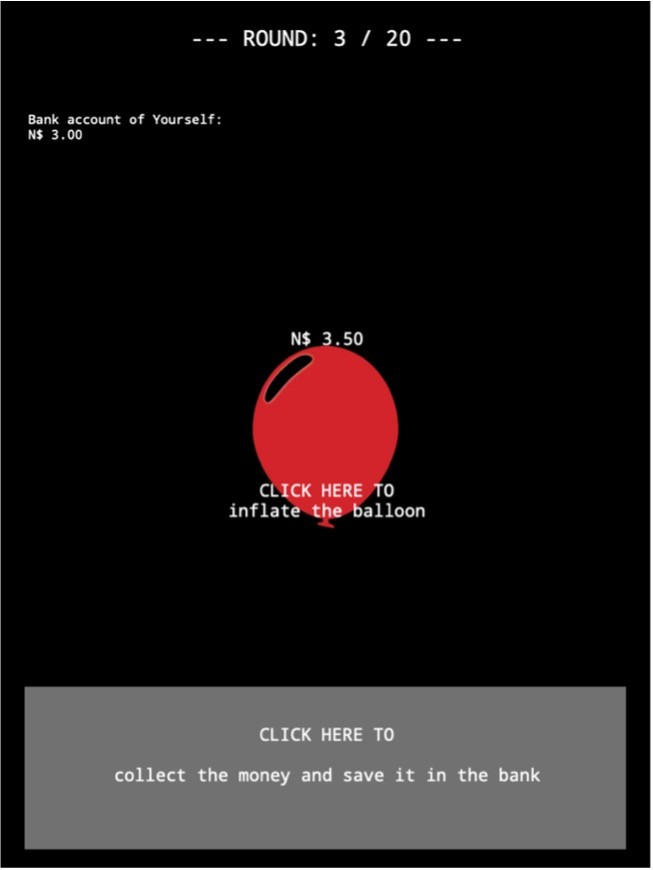
For the study, 152 participants in the coastal city of Swakopmund completed a slightly modified version of the Balloon Analogue Risk Task (BART).
The idea is simple. Participants gradually ‘inflate’ a digital balloon. With every click, representing another breath of air, they earn real money which they can choose to secure at any point. If the balloon bursts before they do so, they lose the money earned in that round. The probability of the balloon bursting increases with every click. Each participant completes 20 balloon rounds.
The average number of clicks before securing the money serves as a measure of willingness to take risks. The higher the number, the greater the participant’s risk tolerance. The test has proved particularly useful in studies involving participants with lower levels of formal education.
The sample could be divided almost evenly into two groups: people with experience of Black Tax and those without. Most participants were women and almost all identified as belonging to population groups that had been classified as ‘Black’ under South Africa’s apartheid regime and had therefore faced historical disadvantage.
Black Tax experience correlates with greater risk aversion
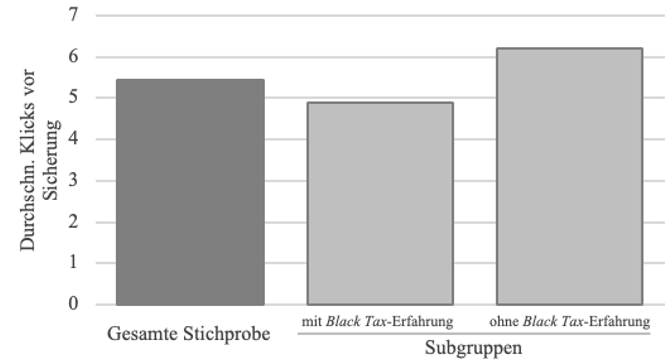
Comparing the average number of clicks before participants secured their money reveals a clear difference: those without experience of Black Tax showed a greater willingness to take risks.
I explored this relationship further using multiple linear regression. The number of clicks was the dependent variable and I tested its correlation with several independent variables. Alongside experience of Black Tax, the analysis considered gender, age, level of education, employment status and ethnic background as potential factors.
The results show a statistically significant correlation between risk-taking and experience of Black Tax (p < 0.05). Experience of Black Tax is associated with 1.05 fewer clicks on average. Given an overall average of 5.4 clicks, this represents a substantial difference. The result also remains stable across several robustness checks.
Inequality cannot simply be undone
The study has clear limitations. The sample is relatively small and geographically concentrated in Swakopmund. Still, the findings provide initial empirical evidence of a relationship between Black Tax and risk-taking behaviour. Further research with larger and more diverse groups of participants could test whether this relationship holds in other settings.
Even within these limitations, an important pattern emerges: people who pass on a significant share of their income to their families as Black Tax tend to be more risk-averse. At a broader societal level, this may create an additional barrier to building wealth.
At the same time, the findings highlight just how complex social inequality can be. Many people continue to depend heavily on financial support from family members. Understanding inequality therefore requires us to consider not only historical injustice but also the social structures that shape economic decisions today.
For me personally, this was also what made the project so rewarding. It allowed me to explore questions in behavioural economics while connecting the analysis closely with history and sociology. Looking at economic decisions through these different perspectives made the research particularly engaging and showed me how much we can learn when we examine individual behaviour within its wider social context.
Jens Spanheimer
For his Bachelor’s thesis in behavioural economics, he examined risk-taking behaviour in a post-colonial context. Alongside his studies, he volunteered with the Red Cross in Namibia and gained practical experience in consulting and development finance.
