33 Laps, 221 Kilometres: What a Backyard Ultra Teaches Us About Leadership

What a Backyard Ultra can teach us about endurance and decision-making
How long would you keep running if nobody knew where the finish line was?
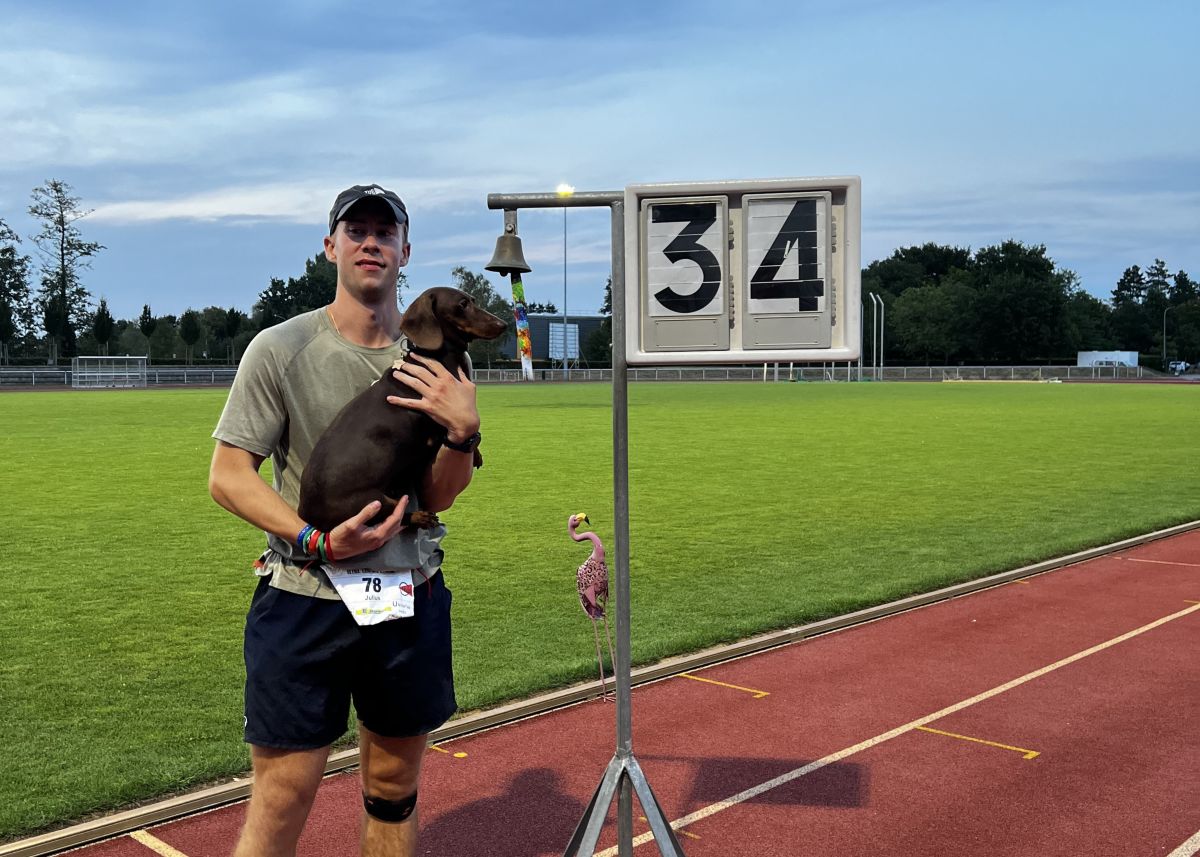
At the Bienwald Backyard Ultra, I found my personal answer: 33 hours, 33 laps and around 221 kilometres. At the same time, I used the challenge to raise funds for the German Childhood Cancer Foundation (Deutsche Kinderkrebsstiftung).
A Backyard Ultra works differently from a traditional marathon or ultramarathon. There is no predefined total distance. Instead, all remaining participants start a 6.706-kilometre lap together every hour. Complete it within the hour and you are allowed to start again. Arrive too late or decide not to continue, and your race is over. The event continues until only one runner remains.
For me, the race ended after 33 laps. What remained was not only 221 kilometres in my legs, but also a number of lessons about managing resources, making decisions under uncertainty and remaining capable of acting even when the ultimate destination is unclear.
Surprisingly, many of these lessons extend far beyond running – into our studies, professional lives and leadership.
Success is not about being the fastest
In a performance-driven society, we often associate success with speed. Those who work faster, decide faster or deliver results faster can appear to have an advantage.
A Backyard Ultra follows a different logic.
Running every lap as fast as possible wastes valuable energy. At the same time, running too slowly leaves little time between laps to eat, drink and recover. Success therefore depends not on maximum speed, but on finding a pace that can be sustained for as long as possible.
Over the course of 33 hours, this became increasingly important to me.
The same principle can be applied to many professional challenges. Sustainable performance rarely comes from operating at maximum capacity all the time. More often, consistency, prioritisation and the careful management of limited resources make the difference in the long run.
This is also a familiar question in management education at Frankfurt School: How can we make decisions not only for the next short-term result, but with their longer-term consequences in mind?
Making decisions under uncertainty
Perhaps the greatest mental challenge of a Backyard Ultra is its constant uncertainty.
At kilometre 30 of a marathon, you know that just over twelve kilometres remain. In a Backyard Ultra, there is no such reference point. After every lap, the question is simply: Will I be back on the start line in an hour?
After ten, twenty or even thirty laps, I still did not know how much longer my race would last.
There is a clear parallel with decision-making in organisations. Leaders rarely have all the information they would like. Markets change, projects develop differently from expectations and strategies need to be adapted.
In this context, resilience does not simply mean enduring for as long as possible. To me, it means assessing the current situation realistically, accepting uncertainty and still being able to make a decision.
A Backyard Ultra reduces that uncertainty to one remarkably simple question: Can I do one more lap?
A greater purpose changes motivation
For me, the Bienwald Backyard Ultra was about more than a sporting challenge. Through the run, I raised funds for the German Childhood Cancer Foundation.
That gave every lap an additional meaning.
It was no longer simply a question of how many kilometres I could complete. Every additional lap also meant more attention for the fundraising campaign and another opportunity to encourage people to support the cause.
After many hours, as the physical and mental strain increases, having such a purpose changes your perspective. The question is no longer simply: How much longer can I run? It becomes: What am I returning to the start line for?
The experience showed me how powerful a greater purpose can be. The same question matters in organisations. People need to understand what they are taking responsibility for and how their actions contribute to a wider objective.
At the same time, the analogy has its limits. An ultramarathon is not the same as leading an organisation, and perseverance is not always the right decision. Responsibility can also mean recognising limits, reassessing a situation and changing course.
Big goals are achieved one lap at a time
As a number, 221 kilometres sounds overwhelming.
But during the race, I never ran “221 kilometres”.
I ran 6.706 kilometres. Then another 6.706. And eventually, another.
Large challenges become more manageable when we break them down into concrete next steps. This applies to academic work, professional projects, personal development and organisational transformation alike.
Of course, we need an idea of where we want to go. But what often matters most is identifying the next action we can actually take.
In a Backyard Ultra, this principle becomes radically simple. You do not need to know whether you can continue for another ten hours. You only need to decide whether you can complete the next lap.
Choosing to go again – 33 times
In the end, I completed 33 laps, 33 hours and around 221 kilometres.
Of course, I would have liked to complete one more. Looking back, however, the number of the lap on which my race ended is not the only measure of success.
Every lap was part of an extraordinary personal challenge. More importantly, every lap helped generate attention for the German Childhood Cancer Foundation and the fundraising campaign.
So what did I take away from those 33 hours?
Major challenges are rarely overcome all at once. They are the result of many small decisions: managing our resources, accepting uncertainty, continuously reassessing the situation and consciously choosing the next step.
At the Backyard Ultra, I made that choice 33 times.
Those 33 laps showed me how far small steps can take us – especially when we are not taking them only for ourselves.
Julius Henry Mundt
