Learning beyond the Classroom

From Taiwan to Germany
“How does your financial research connect to Germany, and why Frankfurt School?” As twenty young students selected by Taiwan’s Ministry of Education for the Taiwan Global Pathfinders Initiative, we had to answer these questions again and again during our interviews. But once we arrived on campus in Frankfurt, those questions turned into a real, exciting journey of learning, adapting, and discovering finance in Europe.
Courses That Made Sense for Everyone
Our group brought together twenty people from all across Taiwan. Even though everyone had some basic knowledge of finance, we came from very different backgrounds and age groups. Designing a two-week program for such a diverse team is definitely not easy. But Frankfurt School did an amazing job. The courses started with clear basic concepts like carbon accounting, and then step by step moved into deeper topics like nature-related risks and FinTech. The pace was just right-no one was left behind, and nobody felt like giving up.
The courses at Frankfurt School gave us a valuable introduction to how environmental and social considerations are becoming part of financial and business decisions. We explored topics such as ESG, climate-related risks, responsible investment, and financial technology, allowing us to build a broader understanding of the changing financial landscape.
What impressed us most was the variety of the programme. In addition to Frankfurt School faculty members, we learned from guest lecturers and experienced industry professionals. They brought first-hand information, practical examples, and current market observations into the classroom. This combination of academic knowledge and industry experience helped us understand not only the concepts but also how they are applied in real business situations.
Learning Through Different Perspectives
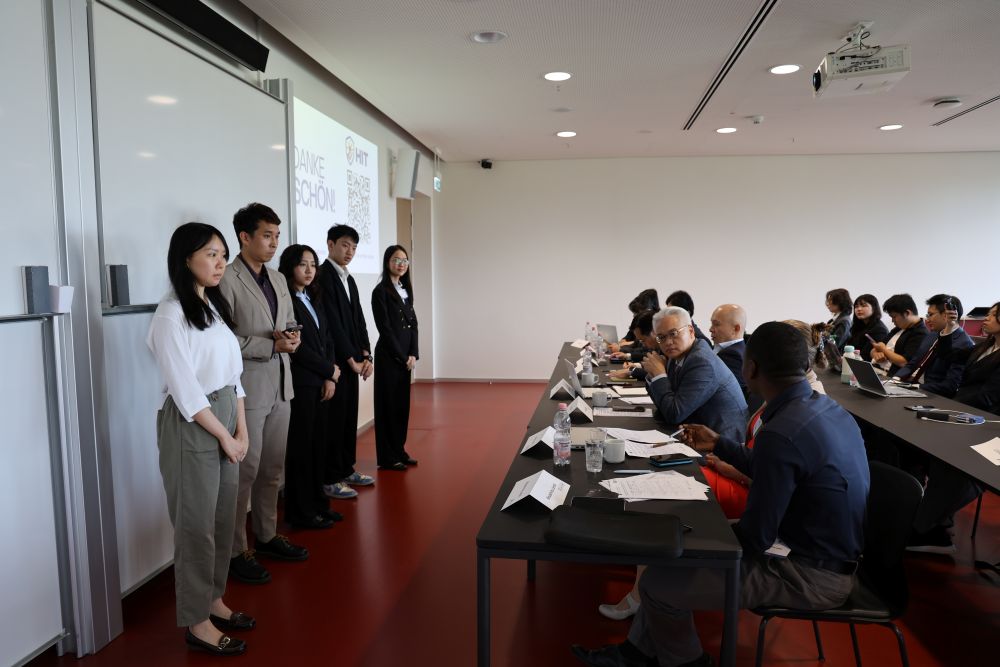
Many sessions used case studies and group discussions. We were asked to examine business challenges, propose solutions, and explain the reasoning behind our decisions. These activities showed us that complex financial and sustainability issues rarely have one absolutely correct answer. Each decision depends on the stakeholders involved, the risks being considered, and the perspective from which the problem is viewed.
Even when different groups discussed the same case, we often reached different conclusions. The professors listened carefully to each group, asked questions, and encouraged us to understand one another’s reasoning. Instead of simply providing a standard answer, they helped us reflect on our assumptions and consider alternative viewpoints.
This learning approach made the program especially meaningful to us. It showed that professional decision-making requires more than technical knowledge. It also requires critical thinking, open communication, and a willingness to understand perspectives different from our own.
High Standards, Active Dialogue, and Mutual Adaptation
Like many students trained in East Asian academic environments, our natural instinct was to listen quietly, absorb lecture material, and reflect internally. At Frankfurt School, however, faculty hold an uncompromising standard for interactive engagement. Every lecture slide invited debate, inquiry, and critical evaluation.
Initially, this cultural disparity created mutual tension. We felt the weight of expectant pauses across the classroom, while professors faced what seemed like an overly hesitant cohort. A few of us approached the instructors after class, explaining that our silence stemmed from respectful listening habits in Taiwan, not a lack of interest. Dr. Christine Grüning graciously assured us that learning is an adaptive dialogue and that the faculty would meet us halfway.
The shift was remarkable. By the second week, hesitations dissolved into vigorous debate. When Christian Hecker brought in industry leaders—such as AllUnity CEO Alexander Höptner and Commerzbank’s Gerald Dannhäuser—our cohort raised challenging, insightful questions on regulatory resilience and stablecoin mechanics. Seeing our professors' genuine satisfaction during those exchanges proved that real learning occurs when both students and educators push each other beyond their comfort zones.
Mentorship Beyond the Classroom
Besides our lecturers, our daily schedule was taken care of by the Sustainable World Academy (SWA) team. Junes Arfaoui, Marco Ciliberti, Moudachirou Lamidi, Siri Duddupudi, and Tzu-Ling Yen were not just coordinators; they were always there with us.
They sat in our classes, helped us when we got stuck on our Capstone Projects, and whenever they had time, they joined our tables at the canteen to eat lunch and chat with us. In Taiwan, having a casual lunch and talking freely with directors and staff rarely happens. At Frankfurt School, it felt completely natural, and it made us feel truly welcome.
Looking Back: More Than Technical Knowledge
Looking back, the question of “Why Germany, and why Frankfurt School?” needs no further theoretical defense. Frankfurt School’s Triple Crown accreditation validates its academic preeminence on paper, but its true excellence is felt in practice: in the courage demanded of students to voice new ideas, in the professors who refuse to settle for passive agreement, and in a team that walks alongside you every step of the way.
After two weeks at Frankfurt School, we returned to Taiwan with more than new knowledge about finance and sustainability. We learned to question assumptions, connect different perspectives, and think about how ideas can be applied in the real world. Being part of an international learning environment also encouraged us to look at our own experiences from a new perspective. We came to Frankfurt to learn from different voices; we left with a deeper understanding of our own and a desire to bring what we learned back home.
If you want to know more about the programme you can get all other information on the Website.
Authors
.Webp%26author%3Dfalse&w=3840&q=85)